
Acts
“You will be my witnesses in Jerusalem, in all Judea and Samaria, and to the ends of the earth…” The book of Acts marks the very beginning of Christian history. Written in a turbulent political climate, amidst the persecution of deranged emperors, the book of Acts chronicles the challenges faced by the earliest Christians as they attempted to navigate what the resurrection truly meant. Themes of the Holy Spirit, what it means to live a holy life, and community with those who come from dramatically different backgrounds fill the pages. As we follow Luke’s narrative, we encounter places such as Akeldama, the Beautiful Gate, and even Herod’s palace where Paul is placed under house arrest. Throughout Paul’s three missionary journeys, we will also examine the world of ancient Rome—full of pagan religious cults, including the cult of Aphrodite, the Delphi Oracle and many others. These will all provide important theological insights that remain relevant even today.

Jesus has risen and ascended, leaving the church in a fragile, somewhat confused state. Let’s take a closer look at what Jesus means by the church receiving power.
Clouds, casting lots, and a field of blood…let’s unpack some confusing developments and consider how the early church leaders stayed on track in their faith despite enormous uncertainty.
Fire raining down on a gathering of people was once a mark of condemnation and division—here, it’s the reversal of Babel, as The Day of Pentecost is marked by supernatural unity.
Visions, dreams, and baptism; Peter offers further clarification of the event that took place in the upper room during Pentecost.
Peter and John heal a man at the Beautiful Gate. Then things in ministry get messy.
Peter and John have upset the authorities…Introducing the High Priest, Annas, his son-in-law, Caiaphas, John and Alexander—also known as the Sanhedrin.
The number 40 and shared suffering bring a community of believers more together than ever.
A married couple seeks to gain status in the church through deceit, and shadows heal people.
The Pharisees versus the Sadducees versus the apostles…Peter and John are thrown in prison and amidst a quarreling Sanhedrin, Rabbi Gamaliel reasons for their lives.
Hellenists versus Hebrews? Elitist leaders? Let’s clarify existing tensions and introduce a new character: Stephen.
One of the chosen leaders of the early church, he is described as full of “grace and power,” and it is said that he performs many miracles “signs and wonders.” In the same way that Peter and John stirred up the authorities, so too Stephen paints a target on his back.
What begins as a sort of history lesson will become Stephen’s final sermon on earth.
At the stoning of Stephen, we are introduced to a man named Saul. This moment will mark Saul for life and later become part of his testimony. Here, however, we see a zealous man who approves of Stephen’s death, and sees it as just and fitting.
Half-breeds, pagans, and magic. Luke introduces us to a man of action, who follows Jesus’ instructions and takes the good news to Samaria.
An angelic messenger and supernatural teleportation…could a conversion narrative ask for more? Perhaps a royal caravan from Ethiopia on holy pilgrimage to worship in Jerusalem? This is one story Luke did not want us to miss.
Divine appointment doesn’t always look divine. Ananias obeyed, but what unfolds for Saul and the apostles is anything but glamorous.
This fast-paced chapter features a near-death escape, rejection countered by brotherhood, and Peter raising a dead girl back to life.
Two men and two visions: one fitting of a Jewish Saint, the other confusing and troubling…the catch? The vision fitting of a devout Jew was given to a Roman Centurion.
The Holy Spirit confirms Peter’s vision, and a kingdom of faith is more fully realized.
Let’s take a look at the significance of the number three and Peter’s call for unity in the early church—even with the Gentiles.
The church at Antioch will be a significant point of ministry for the early church for many reasons, but not insignificant is the fact that it is the first place the disciples are referred to as Christians.
Chapter 12 opens with the murder of James, brother of John by yet another unstable king making life for early Christians increasingly hostile in the Roman Empire. But as tensions increase, so does the presence of heavenly messengers.
An angelic jail break, a house of intercession, and an evil man’s grisly fate. Luke connects the events with deliberate intentionality.
Saul and Barnabas embark on their first mission trip, where they are confronted with depraved cult practices and false prophets.
Paul preaches at the synagogue in Pisidian Antioch, and many are converted. Others, however, are filled with jealousy and proceed to spread confusion through lies.
Many of their fellow Jews have believed, but some stubbornly refuse to listen to Paul and Barnabas. Instead of being deterred by the rejection, they turn their attention to the Gentiles.
A murder plot has Paul and Barnabas on the run to Lystra, where they meet Timothy.
After healing a crippled man, Paul and Barnabas are mistaken for Zeus and Hermes.
Paul is stoned and left for dead…but he and Barnabas refuse to quit. After revisiting to the scene of his attempted execution, the pair finally return home to the church at Antioch to relay the news of their first missionary journey.
In Jerusalem a council is assembled. Circumcision debates, and questions of how a Gentile can follow The Law compose the majority of chapter 15.
Now that a consensus is reached, the church leaders send representatives to the churches and seek to clarify to growing confusion for early believers.
Timothy represents the many levels of complicated that the church is navigating. He’s part Jew, part Greek. And he may be the perfect companion for Paul on a mission to unify the early church.
A wealthy merchant woman provides for the missionaries in the absence of a synagogue or place to stay.
When Paul exorcises a possessed slave girl, her owners drag him and Silas to the marketplace where they are beaten and thrown in prison.
Paul and Silas encounter God’s presence in the most unclean environment imaginable. In the process they are freed, and the Philippian jailer is converted.
A mob forms in Thessalonica, forcing Paul and Silas to flee. They are later reunited in Athens.
Paul attempts to reach the Athenians; his sermon will require a drastically different approach.
When Paul lands in Corinth, he is met with an overwhelmingly pagan and hypersexualized culture. He finds refuge with a married couple who share his faith and will feature prominently throughout the rest of his ministry.
Baptism of John? Or of the Holy Spirit? In chapter 19, Paul shows the power of Jesus over the spiritual realm, leading the people of Ephesus to renounce witchcraft and sorcery in dramatic fashion.
Paul’s message has angered a silversmith, as it has resulted in a loss of business and worship of the goddess Artemis. He incites a dangerous mob, forcing Paul to leave.
A sermon that lasts an entire day puts a church member to sleep, resulting in his fall from a third-story window. But this story doesn’t end with the boy’s death.
Paul is deeply relational and vulnerable with his emotions. The connections he has built are by no means shallow. He has not poured out in simply producing church starts and professional equity, but also relational equity.
An impassioned plea doesn’t stop Paul from a near beating. His status as a Roman citizen, however, will continue to provide Paul a platform.
A point of contention regarding the resurrection that Paul refers to incites a violent dispute between the Sadducees and the Pharisees.
The Sicarri’s plot to kill Paul is foiled by his nephew. The commander sends an entire army with Paul on his way to Caesarea where he remains under house arrest in Herod’s praetorium.
The high priest and elders hire a lawyer, and Paul is dragged before the Roman client-king Herod.
When Paul points to the glaring lack of evidence against him, a corrupt governor goes looking for a bribe.
When politics interfere with Paul receiving a fair trial, Paul has no choice but to appeal to Caesar.
When the corrupt governor Felix is abruptly recalled, Paul must await yet another hearing. A bloody family history and a rumored incestuous brother-sister dynamic color the proceedings of Paul’s hearing before Governor Festus.
A cowardly king knows Paul is innocent but refuses to do the right thing.
Paul is packed onto a grain ship with condemned prisoners, likely headed for the Gladiator arenas. At sea they are hit by a Nor’easter.
An angelic encounter assures Paul of not only his survival but all on board. Shipwrecked, the men are glad to be alive.
A storm, a shipwreck, and a snake bite…Paul turns them into an opportunity and a testimony.
Under house arrest, Paul receives favorable treatment in Rome—likely due to what his assigned guard has witness in their time together. This allows Paul to invite guests, including Jewish religious leaders, where he basically gives his audience a masterclass in what the Old Testament has to say about Jesus.
Pentecost
/ Pen·te·cost / noun
A Christian feast on the seventh Sunday after Easter commemorating the descent of the Holy Spirit on the apostles.
Pharisee
/ phar·i·see / noun
A member of a Jewish sect of the intertestamental period noted for strict observance of rites and ceremonies of the written law and for insistence on the validity of their own oral traditions concerning the law.
Sadducee
/ Sad·du·cee / noun
A member of a Jewish party of the intertestamental period consisting of a traditional ruling class of priests and rejecting doctrines not in the Law (such as resurrection, retribution in a future life, and the existence of angels).

A Coptic Dictionary
W.E. Crum

Evangelical Dictionary
Walter A. Elwell

A Handbook of New Testament Exegesis
Craig L Blomberg
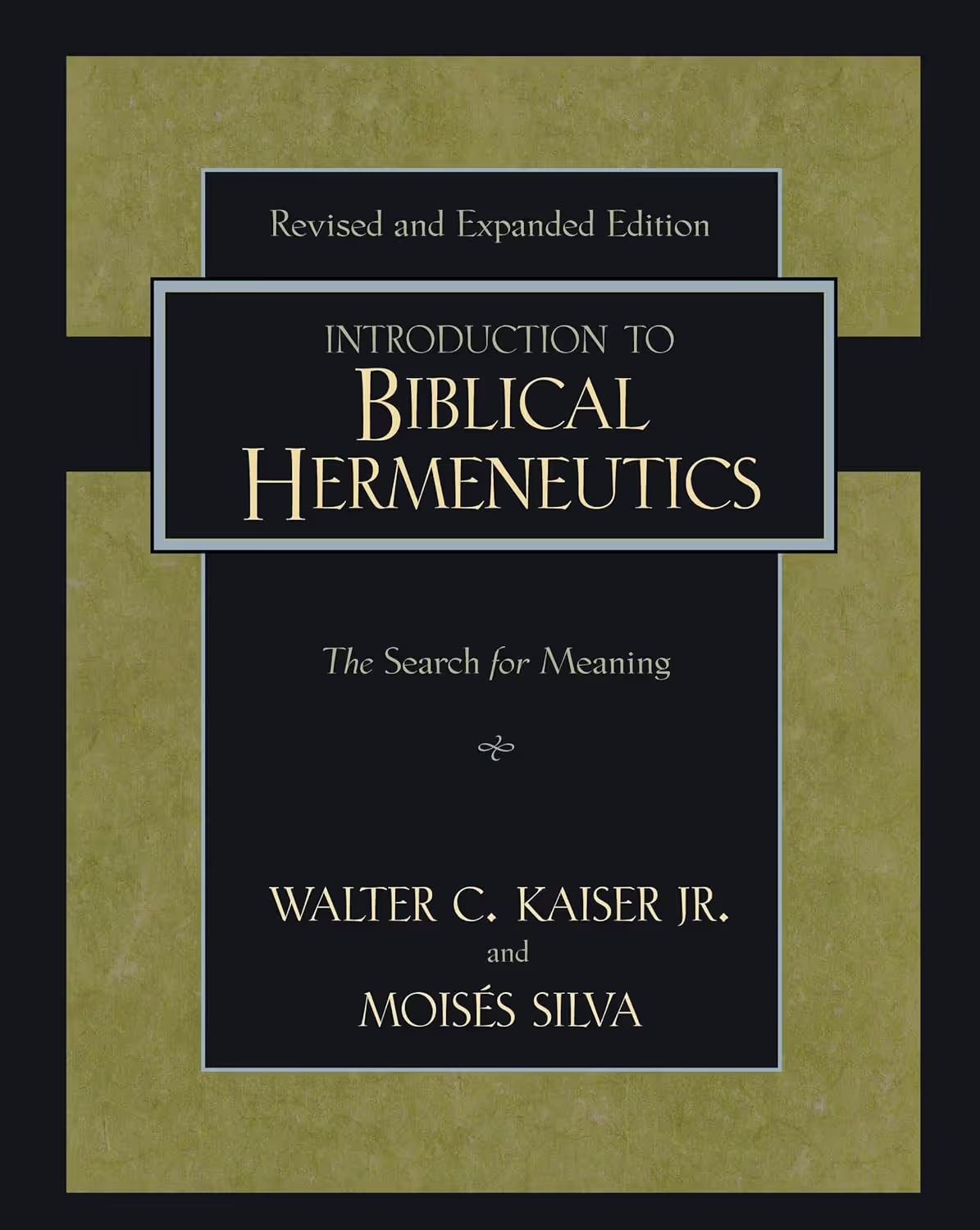
An Introduction to Biblical Hermeneutics; the Search for Meaning
Walter C Kaiser Junior and Moises Silva

Acts 1-9:42
Steve Walton